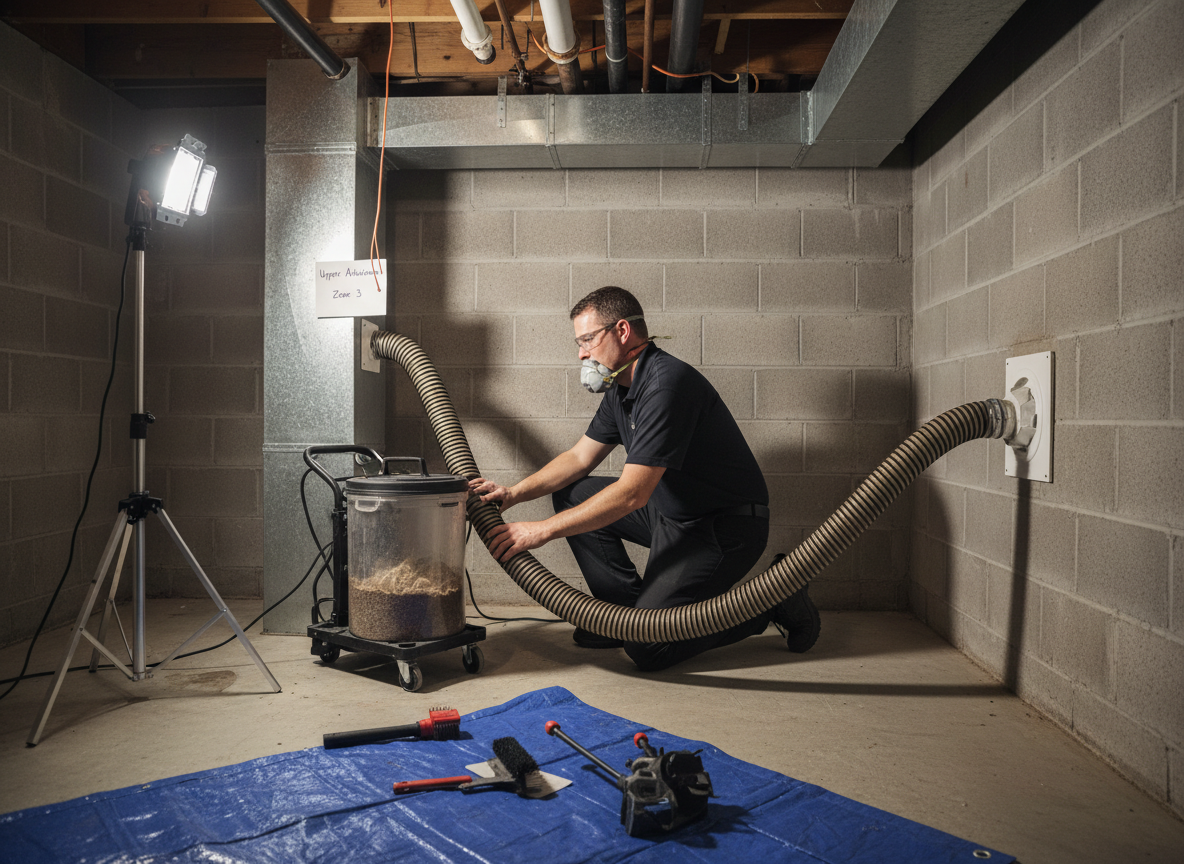
Upper Arlington homes built from the 1920s onward in neighborhoods such as Arlington Ridge and Tremont often feature original metal duct runs that collect pollen, pet dander, and construction debris over decades. The humid continental climate brings heavy spring pollen and winter heating cycles that push fine dust through the same trunks repeatedly. Technicians at FluxVentor start at the 3855 Reed Rd shop, then drive routes past Northam Park and the Upper Arlington Public Library to reach jobs where restricted access points behind finished basements require camera inspection before any vacuuming begins.
Dryer vent cleaning becomes critical after the first hard freeze when lint traps inside wall chases can ice over and block exhaust. In River Ridge and near the Upper Arlington Municipal Center, many two-story colonials route vents through unconditioned attics where temperature swings cause condensation that cakes lint into hard ridges. Crews use rotary brushes sized for 4-inch and 6-inch lines, followed by negative-air machines that pull debris away from living spaces rather than blowing it into finished rooms.
Franklin County soil conditions and occasional high water tables around Grandview Heights can lead to minor foundation shifts that misalign duct joints, creating hidden gaps that pull in crawl-space moisture. During summer humidity spikes this moisture mixes with dust to form sludge that standard household vacuums cannot remove. FluxVentor techs carry flexible whips and HEPA-filtered collection units to handle these edge cases without disturbing insulation or finished ceilings.
Homeowners in Worthington and Upper Arlington frequently discover that shared trunk lines between the main HVAC and second-floor registers require sectional cleaning rather than a single pass. Each register boot is removed, the branch line is brushed, and the main trunk is accessed through the nearest cleanout or return plenum. This method prevents the common mistake of pushing debris from one section into another.
Technician insight
In Upper Arlington the thing that catches most people out with air duct and dryer vent cleaning is how many 1950s and 1960s colonials in Arlington Ridge and Tremont have trunk lines that run through finished ceilings with almost no cleanouts. Once winter temperatures drop and the furnace runs daily, that hidden lint starts moving again and homeowners think the system is just old when it is actually blocked at the elbows.
Blocked dryer vent in Tremont colonial
Homeowner noticed longer drying times and a warm laundry room. Camera inspection showed a 90-degree elbow packed with lint where the vent passed through an exterior wall near Northam Park. Crew removed the exterior hood, ran a rotary brush the full length, and restored full airflow without opening any finished surfaces.
How it works
- 1
Inspection
Technician arrives with inspection camera and maps every accessible trunk and branch in the home, noting access points and any visible gaps.
- 2
Setup
Negative-air machine is connected at the main trunk and registers are sealed to contain debris during brushing.
- 3
Cleaning
Rotary brushes and whips are run through each line while the vacuum pulls material to the collection point outside the living space.
- 4
Dryer Vent
Separate vent line from dryer to exterior termination is brushed and vacuumed, with the exterior hood checked for proper flap operation.
- 5
Final Check
All registers are reinstalled, airflow is verified at each vent, and the homeowner receives a written summary of findings.
Pricing
Pricing varies by number of trunks, access difficulty, and whether dryer vent work is combined; upfront quotes provided after inspection.