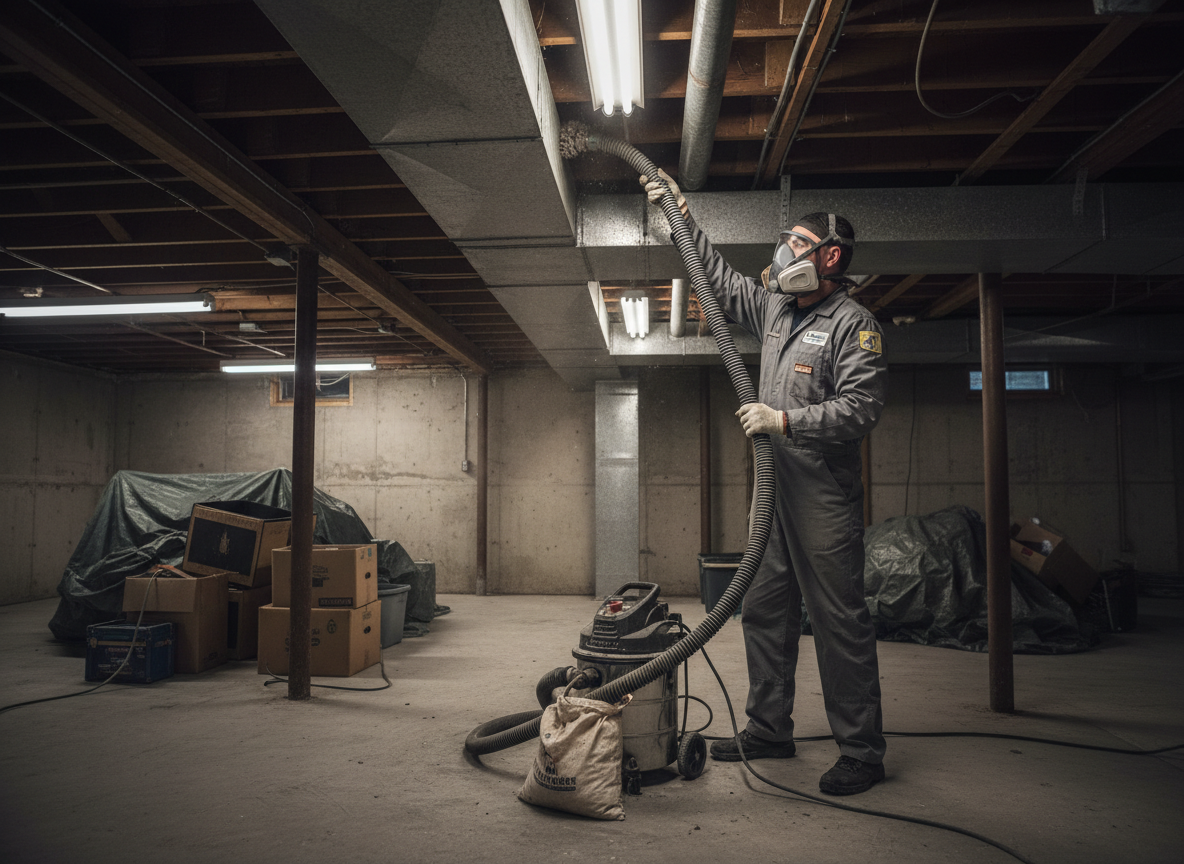
Upper Arlington homes built through the mid-twentieth century in neighborhoods such as Arlington Ridge and River Ridge often route supply and return ducts along basement perimeter walls near the foundation. These runs collect fine silt from the area's humid continental climate, especially after spring thaws and during humid summers that push moisture through slab edges. Cleaning requires reaching trunk lines behind finished walls without disturbing the original galvanized sections still common in Tremont properties.
Basement work here frequently encounters condensation points where ducts pass near cold-water lines or below-grade windows. Technicians must isolate each branch before negative-air extraction to avoid pulling settled dust into living spaces above. Northam Park and Upper Arlington Public Library area homes share similar layouts, so crews map runs from the mechanical room outward rather than assuming standard trunk placement.
Four-season temperature swings in Franklin County accelerate dust caking on basement registers that sit close to floor level. Proper cleaning includes removing the register boots, vacuuming the boot interiors, and confirming airflow balance afterward. This step prevents the short-cycling that older systems in Grandview Heights and Worthington border homes experience when basement ducts remain partially blocked.
Technician insight
In Upper Arlington, the thing that catches most people out with basement air duct cleaning is how many homes in Arlington Ridge still have original ducts running right against the foundation wall; once winter temperatures drop, condensation forms on the metal and pulls fine clay silt from the soil right into the seams, so you end up cleaning the same lines twice as often if you skip sealing those joints.
Tremont Basement Duct Blockage
A homeowner near Northam Park reported weak airflow from basement registers after the first hard freeze. Inspection showed heavy silt buildup where the return trunk sat against the foundation wall. Negative-air cleaning cleared the trunk and branches; airflow returned evenly once the registers were reinstalled.
How it works
- 1
Site Assessment
Map every accessible basement trunk and branch line while noting moisture stains or sagging sections typical in Upper Arlington homes near the Municipal Center.
- 2
Register And Boot Removal
Detach floor and wall registers in the basement, then vacuum each boot interior before sealing the opening to contain debris during extraction.
- 3
Negative-Air Cleaning
Attach the vacuum collection system at the main trunk and agitate each run with brushes sized for the original duct dimensions found in River Ridge and Tremont.
- 4
Reassembly And Airflow Check
Reinstall registers, restore system operation, and verify balanced airflow from the basement mechanical room to upper floors.
Pricing
Cost depends on total linear feet of basement duct and number of finished walls that must be opened for access; upfront quote provided after inspection.