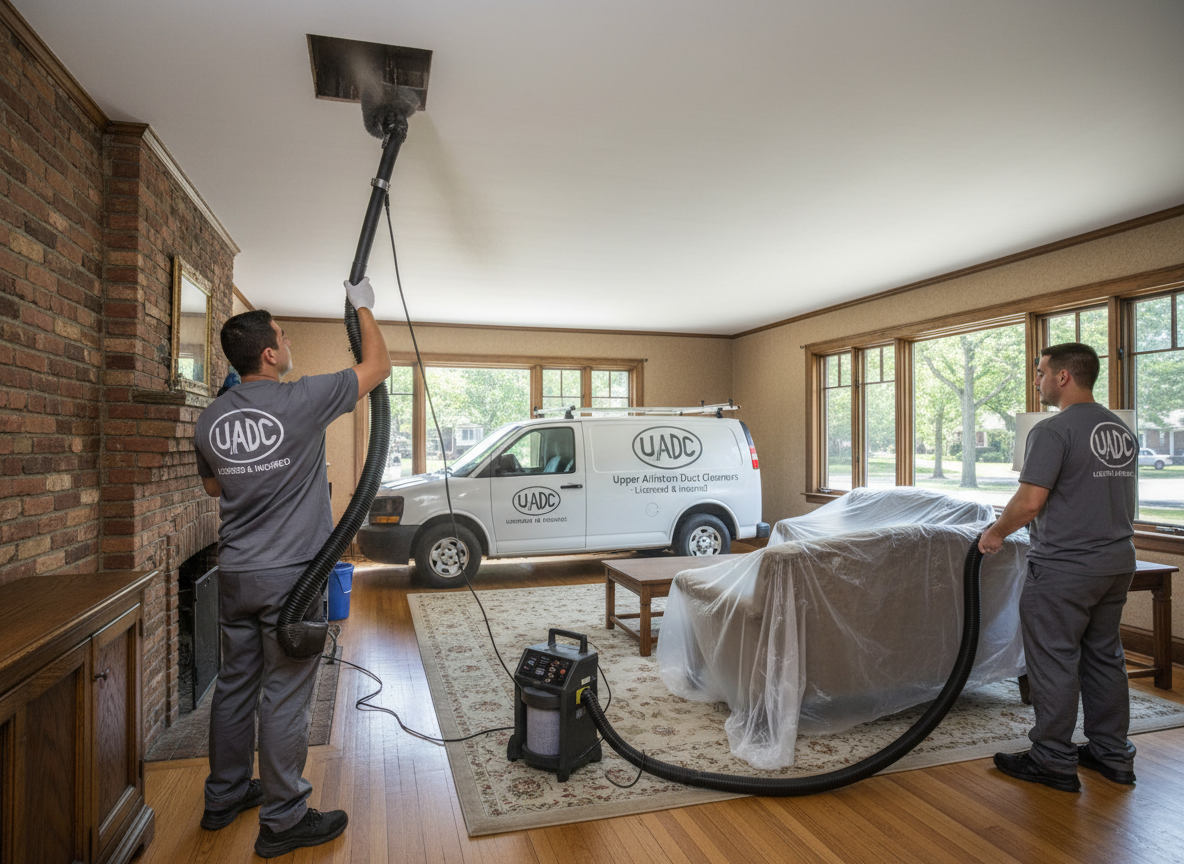
Upper Arlington homes built from the 1920s through 1960s in neighborhoods like Arlington Ridge and Tremont often feature original galvanized or flex duct runs that collect pollen and winter heating residue. A humid continental climate brings heavy summer humidity followed by dry furnace cycles, loosening debris that travels into living spaces near Northam Park and the Public Library. Licensed and insured duct cleaners use negative-air machines with HEPA filtration to capture particles without pressurizing aging joints that can leak in Franklin County basements.
Edge cases appear when crews reach homes bordering Grandview Heights or Worthington where tree roots have shifted foundations and slightly misaligned trunk lines. Technicians must map each branch run before vacuuming to avoid collapsing thin metal elbows common in post-war construction. Work near the Upper Arlington Municipal Center also requires quiet equipment during daytime hours to respect nearby municipal operations.
Homeowners sometimes overlook how seasonal leaf litter from River Ridge yards enters intake vents and accelerates buildup inside supply ducts. Proper licensing ensures crews follow local permitting rules for exterior exhaust placement so debris does not re-enter neighboring properties in Columbus-adjacent blocks.
Technician insight
In Upper Arlington, the thing that catches most people out with licensed and insured duct cleaners is how 1950s ranch homes in Tremont and Arlington Ridge have original ductwork that sags slightly from decades of humid summers and furnace cycles, so aggressive brushing can tear seams if the crew does not first map every low spot.
Hidden blockage near River Ridge
A homeowner noticed weak airflow on the second floor after a cold snap. Inspection revealed compacted dust and leaf debris blocking a main trunk line running under the crawl space. Technicians isolated the section, extracted the material with a flexible brush head, and restored balanced airflow without disturbing the settled foundation soil.
How it works
- 1
Initial Walkthrough
Technician inspects every accessible register and return in the home, noting duct material, access points, and any visible damage from prior HVAC work.
- 2
System Isolation
Registers are sealed and the furnace or air handler is isolated so negative pressure pulls debris only through the intended path without spreading dust into living areas.
- 3
Agitation and Extraction
Rotating brushes and compressed air tools loosen debris while the vacuum unit draws it into sealed collection containers for off-site disposal.
- 4
Final Verification
Each section is re-inspected with a camera and airflow is tested at multiple registers before equipment is removed and the system is returned to normal operation.
Pricing
Upfront quotes based on square footage, number of runs, and access difficulty in older Upper Arlington homes.