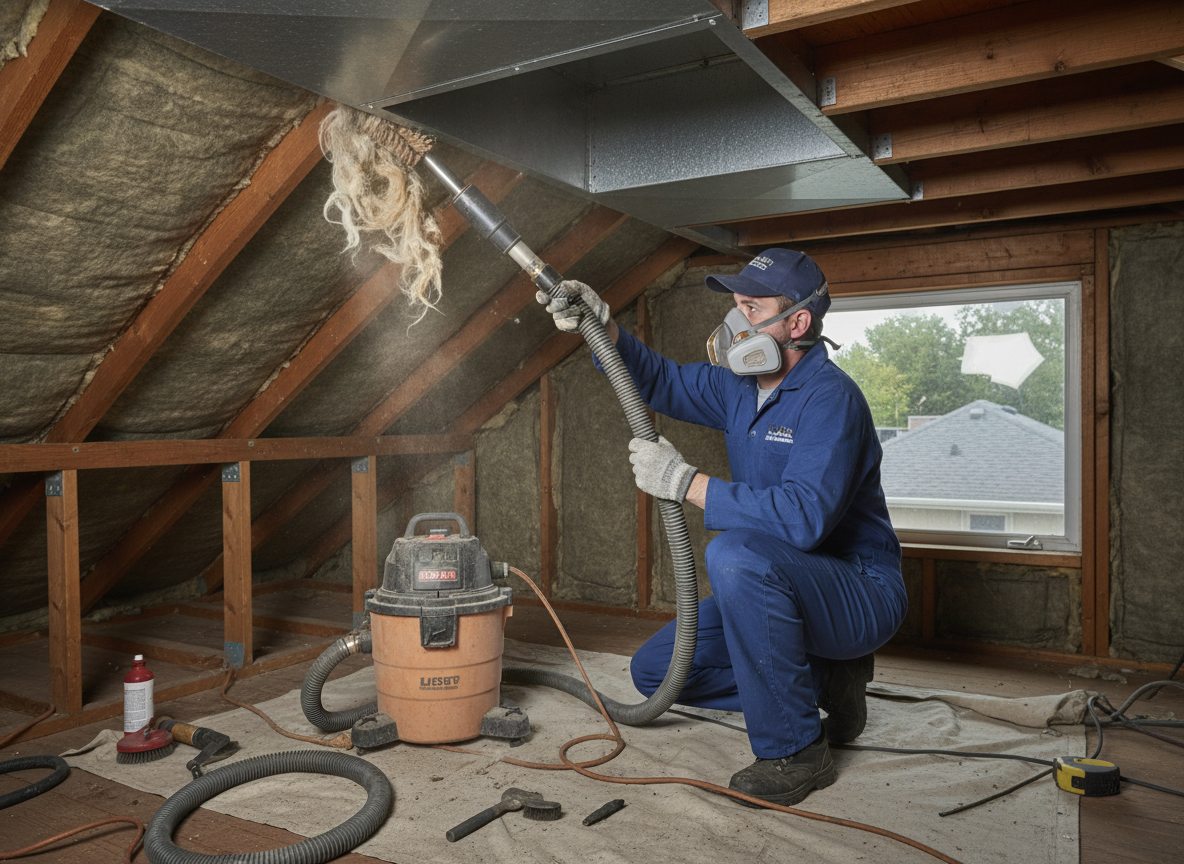
Upper Arlington's mid-century housing stock along Reed Road and near Northam Park often features narrow metal duct runs that trap fine pet hair and dander through repeated heating and cooling cycles. In Franklin County's humid continental climate, summer humidity followed by winter dry air causes hair to clump and adhere to duct walls, reducing airflow and recirculating allergens into living spaces near the Upper Arlington Public Library and Municipal Center. Technicians must use rotary brushes sized for these older systems to avoid damaging seams while reaching bends common in Tremont and River Ridge homes.
Pet hair accumulation accelerates in homes bordering Grandview Heights and Worthington where mature tree cover adds extra dust that mixes with shed fur. Four distinct seasons mean spring pollen and fall leaf debris enter through vents and bond with hair during furnace operation. Cleaning requires negative-air machines to capture particles without spreading them into finished basements or attics typical of these neighborhoods. Skipping the main trunk line near the furnace leaves residue that re-contaminates cleaned branches within weeks.
Homeowners in Arlington Ridge frequently overlook return vents in laundry rooms where pet beds sit, allowing hair to travel the full length of the system. Proper cleaning isolates each branch, agitates with soft-bristle tools, and vacuums to the exterior to prevent re-entry through nearby Columbus-area winds. This approach restores airflow without disturbing insulation in crawl spaces common under 1950s-1970s construction.
Technician insight
In Upper Arlington, the thing that catches most people out with pet hair duct cleaning is the tight 90-degree elbows in 1960s homes around Arlington Ridge where standard brushes stall and hair packs solid after one humid summer and dry winter cycle.
Tremont Home with Multiple Dogs
A River Ridge residence showed reduced airflow after two winters of heavy shedding. Inspection found compacted hair blocking the main return near the furnace. We isolated branches, agitated with appropriate brushes, and extracted the load without disturbing attic insulation. Airflow returned to normal levels and the homeowner reported fewer allergy symptoms.
How it works
- 1
Initial System Mapping
Walk through the home to locate supply and return runs, noting access points in basements or attics common to Upper Arlington properties.
- 2
Negative Air Setup
Connect HEPA-filtered vacuum equipment at the furnace to pull debris outward while protecting living areas near Northam Park.
- 3
Agitation and Extraction
Run rotary brushes through each duct section to loosen embedded pet hair, then extract via the vacuum line.
- 4
Final Inspection and Reassembly
Check all registers and returns for remaining debris before restoring system operation and confirming airflow.
Pricing
Cost depends on number of runs, access difficulty in older homes, and whether multiple pets are present; upfront quotes provided after inspection.